
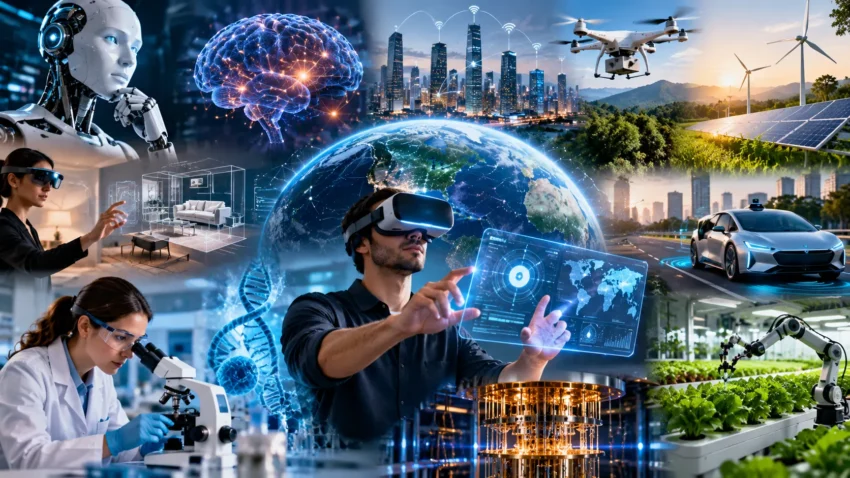
Technology is advancing rapidly, changing how people work, communicate, learn, and interact with the world. From artificial intelligence and quantum computing to advanced robotics and biotechnology, new innovations are creating opportunities across multiple industries. As businesses adopt smarter digital systems, understanding emerging technology trends becomes increasingly important for staying informed about future developments.
So, what are the top 10 emerging technologies expected to shape 2026? Some of the most significant developments include agentic AI, intelligent robotics, quantum computing, post-quantum cybersecurity, spatial computing, and advanced energy technologies. While certain innovations are already being adopted, others remain in experimental or early commercial stages. This guide explores ten important emerging technologies in 2026, their real-world applications, potential benefits, and challenges.
1. Agentic AI and Multiagent Systems
Agentic artificial intelligence is one of the most important emerging technology trends in 2026 because it expands AI beyond answering questions or generating content. Agentic AI systems can work toward defined goals, interact with software tools, and complete connected tasks with varying levels of human supervision. These capabilities introduce new possibilities for business automation and digital assistance.
Multiagent systems take this concept further by allowing specialized AI agents to cooperate on different parts of a larger task. For example, one agent might gather relevant business information while another organizes the findings and a third prepares a report. Coordinating these activities can make certain workflows more efficient when the systems are properly configured and supervised.
Businesses are exploring agentic AI for customer support, administrative processes, software development, and information management. However, autonomous actions introduce concerns involving accuracy, data privacy, security permissions, and accountability. Successful adoption requires clear operational boundaries, human review of important decisions, and reliable methods for monitoring what AI systems are doing.
2. AI-Native Software Development Platforms
AI-native software development platforms are changing how developers design, build, test, and maintain applications. These technologies integrate artificial intelligence into different stages of the software development process rather than treating it as a separate assistance tool. Developers can use AI-powered capabilities to generate code suggestions, explain technical problems, and streamline selected programming activities.
One important development involves systems that can translate natural-language requirements into preliminary application components. For example, a developer might describe a reporting dashboard and receive suggested interface structures or supporting code. This approach can accelerate certain development tasks, although the generated results still require testing, security review, and professional judgment.
AI-assisted development may help smaller teams experiment with software ideas and manage repetitive programming responsibilities. It could also change the skills required for software engineering as developers spend more time reviewing architecture and validating automated work. However, inaccurate code, security weaknesses, and maintenance challenges remain important limitations that organizations must address.
3. Physical AI and Intelligent Robotics
Physical AI combines artificial intelligence with machines capable of sensing, interpreting, and interacting with real-world environments. Unlike software-based AI that operates primarily through digital interfaces, physical AI connects intelligent systems with robots, industrial equipment, and other automated devices. This technology is gaining attention as researchers improve machine perception, motion planning, and environmental understanding.
Intelligent robotics can support manufacturing, warehouse operations, agriculture, and selected service activities. For example, a warehouse robot might identify objects, navigate approved pathways, and assist with moving goods between locations. Advanced systems may adapt to certain environmental changes, although their capabilities depend on sensors, training, software reliability, and operating conditions.
The development of physical AI could improve productivity by supporting repetitive or physically demanding work in controlled environments. However, deploying intelligent machines requires attention to workplace safety, maintenance, costs, and human oversight. Fully autonomous robots capable of handling every unpredictable real-world situation remain a challenging research goal rather than an established everyday capability.
4. Edge AI and Smarter Internet of Things Devices
Edge artificial intelligence allows certain AI calculations to happen directly on devices or nearby computing systems instead of relying entirely on distant cloud servers. This approach can reduce communication delays and limit the amount of information transmitted across networks. It is particularly useful for connected devices that need timely responses or handle sensitive information.
The Internet of Things connects physical objects through sensors, software, and communication networks. When combined with edge AI, these devices can interpret selected information locally and respond more efficiently. Smart cameras, industrial sensors, wearable technology, and connected vehicles are examples of products that may benefit from on-device intelligence.
Edge AI is becoming increasingly relevant as organizations deploy more connected equipment across homes, businesses, and public infrastructure. Local processing can improve responsiveness and sometimes support privacy by reducing unnecessary data transfers. However, device security, computing limitations, software updates, and compatibility remain important challenges for developing reliable connected systems.
5. Quantum Computing and Advanced Simulation
Quantum computing is an emerging technology that uses principles of quantum mechanics to perform certain types of computation. Unlike traditional computers that process information using classical bits, quantum systems use quantum bits, commonly called qubits. These systems may eventually help solve particular problems that are extremely difficult for conventional computing methods.
Researchers are exploring quantum computing applications in chemistry, materials science, optimization, and molecular simulation. For example, quantum simulation could help scientists investigate complex molecular interactions relevant to developing new materials or medicines. However, practical performance advantages depend on the problem and available hardware, and many proposed applications remain experimental.
In 2026, quantum computing continues to face limitations involving hardware stability, error correction, scalability, and operational cost. Current systems are not replacements for ordinary computers used in homes and businesses. Their long-term importance lies in potentially supporting specialized scientific and computational tasks that existing technologies struggle to perform efficiently.
6. Post-Quantum Cryptography and AI-Powered Cybersecurity
Cybersecurity technologies are evolving as businesses face increasingly complex digital threats and prepare for future computing developments. Post-quantum cryptography is especially important because sufficiently powerful quantum computers could eventually threaten some encryption systems used today. New cryptographic algorithms are being developed and adopted to protect information against these potential future capabilities.
Lattice-based cryptography is one important approach within the broader field of post-quantum security. It relies on mathematical problems believed to be difficult for both conventional and quantum computers to solve. Organizations are beginning to plan migrations toward standardized quantum-resistant cryptographic systems, although implementation requires careful evaluation and compatibility testing.
Artificial intelligence is also influencing cybersecurity through automated threat analysis, unusual activity detection, and faster investigation workflows. These capabilities may help security teams identify meaningful patterns across large amounts of information. However, AI systems can make mistakes, and effective protection still requires secure configurations, human expertise, and established incident response procedures.
7. Spatial Computing and Mixed Reality
Spatial computing is an emerging technology that connects digital information with physical environments through sensors, software, and interactive interfaces. It includes applications involving augmented reality, virtual reality, and mixed reality experiences. Instead of interacting exclusively through flat screens, users can explore digital content positioned within simulated or real-world spaces.
One example involves engineers using mixed reality to examine digital representations of equipment before physical installation. Educational institutions may also use immersive simulations to help students understand complex structures or technical concepts. These experiences can support visualization and learning, although their effectiveness depends on the application, hardware, and educational design.
Spatial computing may influence architecture, training, product design, entertainment, and selected professional workflows in 2026. Improvements in wearable displays, environmental tracking, and computing performance could make these experiences more practical. However, equipment cost, accessibility, user comfort, and privacy considerations remain barriers to widespread adoption across everyday activities.
8. Digital Twins and AI World Models
Digital twins are virtual representations of physical objects, processes, or systems that can use real-world information to support monitoring and analysis. Businesses may use digital twins to study how equipment performs under different operating conditions. These models can help teams evaluate possible improvements before making changes to physical systems.
AI world models represent another developing technology focused on learning how environments behave and predicting possible outcomes. By analyzing information from videos, sensors, and other data sources, these systems attempt to understand physical relationships. Researchers are exploring their potential for robotics, simulation, and situations where AI must reason about unfamiliar environments.
Combining advanced simulation with AI could help organizations improve planning, equipment maintenance, and operational decision-making. For example, a manufacturer might study equipment behavior in a virtual environment before adjusting production processes. However, prediction quality depends on accurate information, suitable modeling assumptions, and careful validation against real-world results.
9. Smart Energy Storage and Everything-to-Grid Technology
Energy technology is becoming increasingly important as electricity demand grows and more renewable energy systems connect to power networks. Everything-to-grid technology allows suitable distributed resources, including electric vehicles and stationary batteries, to store electricity and return it when needed. This approach could make energy systems more flexible during periods of changing supply and demand.
For example, a household battery might store excess solar electricity during daylight hours and supply energy later. With compatible equipment and grid arrangements, stored electricity could also support wider electricity networks during selected periods. Coordinating these resources requires suitable control software, communication systems, and agreements between participants and electricity providers.
Advanced battery research and improved grid management are helping expand the possibilities for distributed energy storage. However, practical adoption depends on equipment costs, battery durability, infrastructure compatibility, and local electricity regulations. These technologies are important because they could support more efficient energy management while helping electricity networks accommodate changing generation patterns.
10. Synthetic Biology and Precision Fermentation
Synthetic biology combines biological science with engineering approaches to design or modify biological systems for useful purposes. Researchers and businesses are exploring applications involving medicine, materials, agriculture, and industrial production. Advances in genetic analysis, computational tools, and laboratory methods are expanding the possibilities for developing specialized biological products.
Precision fermentation is one emerging application that uses microorganisms to manufacture specific proteins, enzymes, and other substances under controlled conditions. For example, specially developed microorganisms can produce certain dairy-related proteins without relying on traditional animal-based production methods. The resulting ingredients may support food manufacturing and other industrial applications, depending on regulatory approvals and commercial feasibility.
These technologies could influence how businesses manufacture ingredients, develop materials, and investigate new biological solutions. However, production costs, quality control, safety testing, and regulatory requirements remain significant considerations. Their long-term potential depends on whether successful scientific developments can be translated into reliable, affordable, and responsibly managed commercial processes.
How Will Emerging Technologies Affect Businesses and Careers?
Emerging technologies are expected to influence business operations by changing how organizations process information, develop products, and manage everyday activities. Artificial intelligence, advanced automation, and connected systems may help teams complete certain tasks more efficiently. However, technology adoption also requires suitable planning, employee training, and careful evaluation of potential benefits.
Career opportunities may develop in fields such as AI engineering, cybersecurity, robotics, cloud computing, biotechnology, and renewable energy. Professionals who understand both technical concepts and practical business applications may find opportunities to contribute to new projects. Learning adaptable skills, including analytical thinking, communication, and digital literacy, can help people prepare for changing workplace requirements.
Businesses should avoid adopting emerging technologies simply because they attract attention or appear innovative. A practical strategy begins by identifying real problems, testing appropriate solutions, and measuring whether the technology delivers useful results. Considering costs, safety, privacy, and long-term maintenance helps organizations make better decisions while reducing unnecessary risks associated with rapid technological change.
Conclusion
The top 10 emerging technologies shaping 2026 demonstrate how innovation is expanding across artificial intelligence, computing, cybersecurity, energy, and biotechnology. Agentic AI, intelligent robotics, quantum computing, and spatial computing are introducing new possibilities for digital and physical systems. Meanwhile, technologies such as precision fermentation and advanced energy storage could influence essential industries.
Not every emerging technology will become widely available or commercially successful within the same timeframe. Some innovations are already supporting practical business activities, while others remain in research, testing, or early deployment. Understanding these differences is important because technological potential does not automatically guarantee immediate results or universal adoption.
As technology continues developing, individuals and businesses can benefit from learning about important trends without relying on unrealistic predictions. Developing relevant skills, evaluating practical applications, and understanding possible limitations are sensible ways to prepare. The technologies that create lasting value will ultimately be those that solve meaningful problems responsibly and effectively.
Frequently Asked Questions (FAQs)
What are the top 10 emerging technologies in 2026?
Ten notable emerging technologies include agentic AI, AI-native software development, intelligent robotics, edge AI, quantum computing, post-quantum cryptography, spatial computing, digital twins, smart energy systems, and synthetic biology.
Which emerging technology is growing the fastest in 2026?
Artificial intelligence is experiencing rapid development and investment, particularly in AI agents, software development tools, and automation. However, growth varies by market, and no single technology leads every measure of adoption or commercial value.
How will emerging technologies change jobs in the future?
Emerging technologies may automate selected tasks while creating new responsibilities in technology development, security, maintenance, and oversight. Workers can prepare by developing digital skills, problem-solving abilities, and knowledge relevant to their industries.
Is quantum computing expected to become mainstream in 2026?
No, quantum computing is still developing and remains primarily focused on specialized research and early commercial applications. Significant technical challenges must be addressed before quantum systems become broadly useful for everyday computing.
Why are emerging technologies important for businesses?
Emerging technologies can help businesses explore new products, improve certain processes, and respond to changing customer expectations. Their value depends on practical suitability, implementation costs, security, and whether they solve meaningful business problems.