

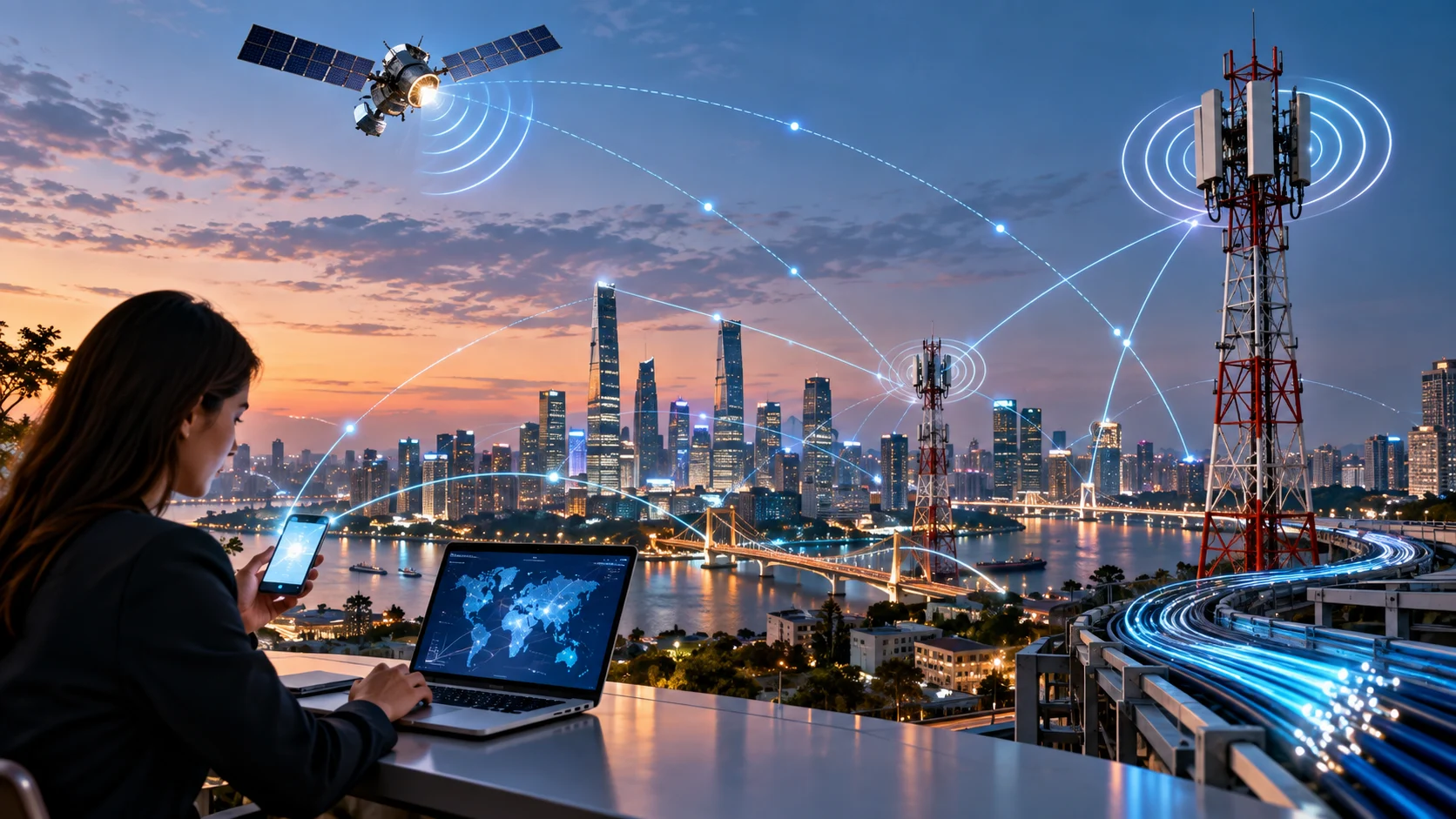
Telecommunications is the process of sending information over a distance using electronic and digital technologies. It allows people, computers, businesses, and connected devices to exchange voice, text, video, and data almost instantly. From traditional telephone calls to modern 5G networks and fiber-optic internet, telecommunications plays a central role in everyday communication.
Modern society depends heavily on telecommunications infrastructure to keep people and organizations connected. Mobile phones, broadband internet, television broadcasts, satellite services, and business communication platforms all rely on telecom networks. These systems operate through a combination of transmitters, receivers, cables, radio waves, network equipment, and data processing technologies.
Understanding what telecommunications is and how it works makes it easier to understand the technology behind phone calls, internet connections, wireless networks, and digital services. Although telecom networks can be highly complex, the basic concept is straightforward. Information is converted into signals, transmitted through a communication medium, and then converted back into information at its destination.
What Is Telecommunications?
Telecommunications refers to the electronic transmission of information between two or more locations. The information being transmitted may include voice conversations, text messages, photographs, videos, computer data, or other digital content. Communication can take place through wired networks, wireless signals, satellites, fiber-optic cables, or combinations of several technologies.
The term combines “tele,” meaning distance, with “communication,” which describes the exchange of information. Telecommunications therefore allows information to travel beyond normal physical communication limits. A person making a mobile call across a city and a company transferring data between offices in different countries are both using telecommunications systems.
Telecommunications includes much more than traditional telephone services. Internet service providers, mobile network operators, satellite companies, cable television providers, data centers, and cloud communication platforms are all part of the broader telecom ecosystem. Together, these technologies form the communication infrastructure that supports modern homes, businesses, governments, and connected devices.
How Does Telecommunications Work?
Telecommunications begins when information is created by a source device, such as a smartphone, computer, television camera, or telephone. The device converts that information into an electrical, optical, or radio signal that can travel across a communication network. Digital systems normally convert voice, video, and other content into binary data before transmission begins.
The signal then travels through a transmission medium such as copper wire, fiber-optic cable, microwave links, satellite connections, or radio waves. Network equipment directs the information toward its intended destination through multiple communication points. Routers, switches, antennas, base stations, and exchanges help ensure that the information follows an appropriate path.
When the signal reaches the receiving device, it is decoded and converted back into a usable format. For example, digital voice data arriving at another smartphone is transformed into sound that the recipient can hear. This process happens extremely quickly, making conversations, streaming, messaging, and online communication appear almost instantaneous.
Main Components of a Telecommunications System
Every telecommunications system requires a source that produces the information being transmitted. This source may be a person speaking into a phone, a computer sending an email, or a camera streaming video. A transmitter processes that information and converts it into a signal that can travel through the selected communication channel.
The transmission medium carries the signal from one location to another. Depending on the network, this medium may include copper cables, fiber optics, radio frequencies, microwave signals, or satellite links. Different transmission technologies provide different levels of speed, coverage, capacity, reliability, and resistance to signal interference.
A receiver completes the communication process by accepting and decoding the incoming signal. Networks also use additional equipment such as routers, switches, repeaters, servers, amplifiers, and gateways to manage communication traffic. These components work together to move large volumes of data efficiently while ensuring that information reaches the correct users and devices.
Types of Telecommunications Networks
Telephone networks are among the oldest and most recognizable types of telecommunications systems. Traditional landline networks originally relied heavily on copper wires and circuit switching to establish connections between callers. Modern telephone infrastructure increasingly uses digital technologies and internet-based systems to provide clearer, faster, and more flexible voice communication.
Mobile telecommunications networks allow users to communicate while moving between different geographic locations. These networks divide service areas into cells that are supported by cellular towers and base stations. Smartphones connect wirelessly to nearby towers, allowing users to make calls, browse websites, send messages, stream videos, and access applications without physical network cables.
Computer and data networks are another major part of telecommunications. Local area networks, wide area networks, private corporate networks, and the internet enable computers and connected devices to exchange digital information. These networks rely on communication protocols, routers, servers, transmission links, and addressing systems to move information between millions of connected endpoints.
Wired and Wireless Telecommunications
Wired telecommunications uses physical cables to carry signals between devices and network infrastructure. Common wired technologies include copper telephone lines, coaxial cables, Ethernet cables, and fiber-optic connections. Wired networks often provide stable performance, strong security options, and high data capacity, making them important for homes, offices, data centers, and backbone internet infrastructure.
Wireless telecommunications transmits information through electromagnetic waves instead of physical cables between the user and the communication point. Cellular networks, Wi-Fi, Bluetooth, radio broadcasting, and satellite communication are common examples. Wireless technology provides greater mobility and flexibility because users can remain connected without being physically attached to network equipment.
Many modern communication systems combine wired and wireless technologies rather than relying entirely on one approach. A smartphone may connect wirelessly to a cellular tower, while the tower connects to the wider telecommunications network through fiber-optic cables. This combination provides convenient wireless access while benefiting from the high capacity of wired backbone infrastructure.
How Signals Carry Information
Signals are the foundation of telecommunications because they allow information to travel through communication networks. Analog signals change continuously and were historically common in traditional telephone and broadcasting systems. Digital signals represent information using numerical values, usually binary digits, making them suitable for modern computers, mobile networks, internet services, and digital communication platforms.
Before information is transmitted, it may undergo a process called modulation. Modulation adjusts characteristics of a carrier signal so that voice, video, or data can be transported efficiently. Different telecommunications technologies use different modulation techniques depending on available bandwidth, transmission distance, network capacity, interference conditions, and the type of information being communicated.
The receiver performs the reverse process by identifying and decoding the transmitted information. Error detection and correction technologies may also be used to identify information that becomes damaged during transmission. These techniques help modern telecommunications networks provide reliable connections even when signals travel long distances or experience interference from environmental and electronic sources.
The Role of Fiber Optics in Telecommunications
Fiber-optic technology has become one of the most important parts of modern telecommunications infrastructure. Instead of transmitting information through electrical signals inside metal wires, fiber cables carry information using pulses of light. These extremely thin glass or plastic fibers can transport large amounts of digital data across significant distances at very high speeds.
Fiber networks offer several advantages compared with many traditional copper-based communication systems. They provide high bandwidth, low signal loss, fast data transmission, and strong resistance to electromagnetic interference. Because of these benefits, fiber-optic connections are widely used for broadband internet, telecommunications backbones, business networks, international connections, and connections between major data centers.
Undersea fiber-optic cables are particularly important for global telecommunications. These cables run across oceans and connect countries and continents, carrying enormous amounts of international internet and communication traffic. Although satellite technology also supports international connectivity, submarine fiber networks handle a significant amount of high-capacity communication because of their speed and ability to transport large data volumes.
How Mobile Telecommunications Works
Mobile telecommunications relies on cellular networks that divide geographic regions into smaller coverage areas known as cells. Each cell is served by network equipment such as antennas and base stations that communicate with nearby mobile devices. When someone uses a smartphone, the device automatically connects to an available network site using assigned radio frequencies.
When a person makes a mobile call or uses mobile internet, information travels wirelessly from the device to the nearest suitable base station. From there, the telecommunications network routes the voice or data toward its destination. Network systems constantly manage connections, available spectrum, user authentication, traffic levels, and movement between different cellular coverage areas.
As the user moves, the mobile connection may be transferred from one cell to another through a process commonly called handover or handoff. This allows a phone call or internet session to continue while someone travels through different network areas. Technologies such as 4G LTE and 5G have improved mobile speeds, network capacity, latency, and support for connected devices.
The Role of Satellites in Telecommunications
Satellite telecommunications uses communication satellites positioned above Earth to transmit signals between distant locations. Ground stations send radio signals toward satellites, which receive, process, and retransmit those signals toward another geographic area. This technology can provide communication services across large regions where building extensive terrestrial infrastructure may be difficult or economically impractical.
Satellites support television broadcasting, internet connectivity, telephone communication, navigation services, weather monitoring, and emergency communications. They are particularly useful for ships, aircraft, remote communities, rural regions, and temporary operations where traditional cable infrastructure is unavailable. Different satellite systems operate at different orbital heights and offer varying coverage, capacity, and latency characteristics.
Modern low Earth orbit satellite networks are changing how satellite internet services operate. Because these satellites orbit closer to Earth than traditional geostationary satellites, they can offer lower communication delays in certain applications. Satellite telecommunications therefore continues to complement cellular, fiber, and other terrestrial networks by expanding connectivity into locations that are difficult to reach.
Telecommunications and the Internet
The internet depends heavily on telecommunications infrastructure to connect computers, servers, smartphones, and other digital devices worldwide. Internet data travels across networks operated by telecommunications companies, internet service providers, data centers, and network exchanges. Fiber cables, wireless systems, routers, and international connections work together to move information between users and online services.
When someone opens a website, their device sends a request through an internet connection toward the server hosting the website. The data may travel through several routers and network providers before reaching the destination server. The requested information then travels back through communication networks, allowing the webpage, image, video, or application content to appear on the user’s device.
Telecommunications and internet services have become increasingly interconnected because many traditional communication services now operate using internet protocols. Voice over Internet Protocol, video conferencing, cloud phone systems, and messaging applications transmit communication as digital data. This convergence allows businesses and consumers to use a single network infrastructure for many different communication services.
Why Telecommunications Is Important
Telecommunications allows individuals to communicate across cities, countries, and continents without needing to be physically present in the same location. People can make calls, send messages, attend virtual meetings, access online education, and communicate with family members almost instantly. Reliable connectivity has therefore become an important part of personal communication and everyday digital life.
Businesses rely on telecommunications for customer service, remote work, online sales, supply chain coordination, financial transactions, and communication between offices. Cloud platforms and digital collaboration tools also depend on reliable network connectivity. Strong telecommunications infrastructure can help companies communicate faster, operate across multiple locations, and serve customers beyond their immediate geographic markets.
Telecommunications is also important for public services, healthcare organizations, emergency responders, transportation systems, and government operations. Communication networks help organizations exchange information during emergencies and coordinate essential services. As digital systems become more connected, dependable telecom infrastructure becomes increasingly important for economic activity, public communication, and access to information.
Modern Telecommunications Technologies
Fifth-generation mobile technology, commonly known as 5G, is one of the major developments shaping modern telecommunications. It is designed to provide higher network capacity, faster data speeds, and lower latency than previous mobile generations under suitable conditions. These improvements can support applications involving smart devices, industrial systems, connected vehicles, remote operations, and high-bandwidth digital services.
The Internet of Things is also expanding the role of telecommunications beyond communication between people. Smart meters, security cameras, sensors, wearable devices, industrial equipment, and connected home appliances can communicate through telecom networks. These devices continuously exchange small or large amounts of information with applications, cloud platforms, and other connected systems.
Cloud communication, artificial intelligence, software-defined networking, and network virtualization are also changing how telecommunications services are managed. Operators can increasingly control network resources through software instead of depending entirely on dedicated physical equipment. These technologies can improve automation, flexibility, resource allocation, network monitoring, and the delivery of customized communication services.
Conclusion
Telecommunications is the technology that makes long-distance electronic communication possible. It allows voice, data, video, and other forms of information to travel between people, computers, businesses, and connected devices. The process usually involves converting information into signals, transmitting those signals across a network, and decoding them at the destination.
Modern telecommunications networks use technologies such as fiber optics, cellular towers, satellites, radio frequencies, routers, switches, servers, and internet protocols. Wired and wireless systems often work together to provide reliable communication across local and global networks. These interconnected technologies allow billions of users and devices to exchange information every day.
As technologies such as 5G, fiber broadband, cloud networking, satellite internet, and the Internet of Things continue developing, telecommunications will remain essential to digital communication. Faster and more flexible networks will support new applications and connected services. Understanding how telecommunications works provides a useful foundation for understanding the wider digital world.
Frequently Asked Questions
What is telecommunications in simple words?
Telecommunications means sending information over a distance using electronic technology. It includes phone calls, mobile networks, internet connections, radio, television, satellite communication, messaging, and other forms of digital communication.
What are some examples of telecommunications?
Common examples include landline phones, smartphones, broadband internet, Wi-Fi networks, television broadcasting, radio communication, satellite internet, video conferencing, text messaging, and business communication systems.
What are the main components of telecommunications?
The basic components include an information source, transmitter, communication channel or transmission medium, network equipment, and receiver. Together, these components convert, transport, route, and decode communication signals.
What is the difference between telecommunications and networking?
Telecommunications broadly covers transmitting information over distances, while networking usually focuses on connecting computers and digital devices so they can exchange data. Computer networking is therefore an important part of modern telecommunications.
How does telecommunications affect everyday life?
Telecommunications supports phone calls, internet browsing, online banking, remote work, streaming, education, healthcare communication, navigation, and emergency services. It provides the connectivity needed for many everyday digital activities.