
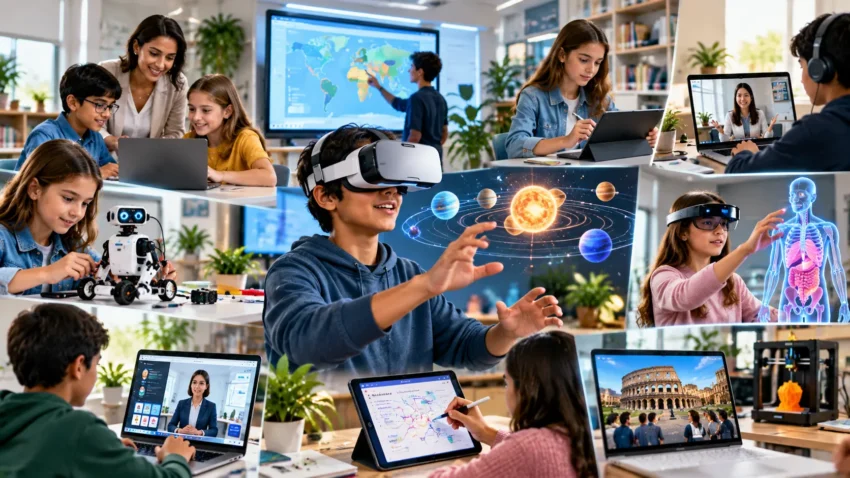
Technology is transforming education by changing how students learn, teachers deliver lessons, and educational institutions manage their resources. Traditional classrooms are increasingly incorporating digital tools that make learning more interactive, accessible, and personalized. From artificial intelligence to virtual reality, emerging technologies in education are creating new opportunities for students and educators around the world.
Understanding the 8 types of emerging technologies in education can help teachers, students, and school administrators recognize how modern innovations support learning. These technologies include artificial intelligence, augmented reality, virtual reality, blockchain, the Internet of Things, adaptive learning systems, cloud computing, and educational robotics. Each technology offers different capabilities that can improve teaching methods, classroom engagement, and educational experiences.
However, adopting new educational technology requires more than introducing digital devices into classrooms. Schools must also consider accessibility, data privacy, teacher training, learning objectives, and implementation costs. This guide explores eight important emerging educational technologies, their practical applications, potential benefits, and challenges to help educators understand the future of digital learning.
What Are Emerging Technologies in Education?
Emerging technologies in education are innovative digital tools and systems that introduce new approaches to teaching, learning, and educational management. These technologies use developments in computing, connectivity, automation, and interactive media to support educational activities. Their purpose is to expand learning opportunities, improve access to information, and help educators address different student needs.
Examples of emerging educational technologies include artificial intelligence learning platforms, immersive virtual environments, connected classroom devices, and personalized learning applications. Some technologies are already widely used, while others remain experimental or are gradually becoming more accessible. Their educational value depends on how effectively they support teaching goals and meaningful student participation.
Educational technology does not replace the importance of teachers, classroom discussions, or human relationships. Instead, carefully selected tools can complement traditional learning methods and provide additional opportunities for engagement. Schools must evaluate whether a particular technology improves learning outcomes rather than assuming that newer systems automatically produce better educational experiences.
1. Artificial Intelligence (AI) in Education
Artificial intelligence is one of the most significant emerging technologies in education because it enables computer systems to perform tasks involving language processing, pattern recognition, and automated recommendations. AI-powered educational applications can support tutoring, content creation, feedback, and administrative activities. These capabilities are changing how students interact with learning materials and how educators organize classroom tasks.
AI tutoring systems can explain academic concepts, generate practice questions, and provide feedback based on student responses. Teachers may use artificial intelligence tools to prepare lesson outlines, develop classroom activities, and organize instructional resources. Some applications also analyze learning patterns to identify subjects where students may benefit from additional guidance.
Despite these benefits, artificial intelligence introduces challenges involving accuracy, student privacy, academic integrity, and unequal access. AI-generated explanations can contain mistakes, making teacher supervision and independent verification important. Educational institutions should establish clear guidelines that encourage responsible AI use while protecting critical thinking, creativity, and meaningful student learning.
2. Augmented Reality (AR) in Education
Augmented reality is an interactive technology that adds digital information, images, or three-dimensional objects to a view of the real world. In education, AR applications can make abstract subjects easier to visualize by displaying virtual content alongside physical surroundings. Students can explore educational models through compatible smartphones, tablets, or specialized devices.
For example, augmented reality can help science students examine three-dimensional models of the human body or explore representations of molecules. Geography lessons may use interactive maps, while history activities can display reconstructions of historic structures. These experiences provide additional visual context that may help students understand concepts that are difficult to explain through textbooks alone.
AR technology can increase classroom engagement when activities are connected to clear learning objectives. However, device compatibility, software quality, accessibility, and classroom management can influence its effectiveness. Teachers should select appropriate applications and ensure that interactive features support understanding rather than becoming distractions from the lesson.
3. Virtual Reality (VR) in Education
Virtual reality allows students to experience computer-generated environments that create a sense of being present in a simulated setting. VR systems commonly use headsets and interactive controls to provide immersive visual experiences. Educational institutions can use these environments to demonstrate complex ideas, explore virtual locations, and support certain forms of practical training.
Virtual field trips are among the most recognizable applications of VR in education. Students may explore digital representations of museums, historical sites, scientific environments, or geographical locations without physically traveling there. Some professional training programs also use virtual simulations to help learners practice decision-making in controlled educational scenarios.
Although virtual reality provides interesting opportunities, it also presents practical limitations. Equipment costs, technical requirements, accessibility concerns, and possible discomfort can affect classroom use. VR activities should be age-appropriate, supervised when necessary, and balanced with other teaching methods to ensure that immersive experiences contribute to meaningful learning.
4. Blockchain Technology in Education
Blockchain is a digital recordkeeping technology that stores information across connected systems using methods designed to make unauthorized changes easier to detect. In education, blockchain applications are being explored for managing academic credentials, certificates, and verified learning records. These systems may help institutions and authorized organizations confirm educational achievements more efficiently.
One potential application involves issuing digital diplomas or certificates that can be independently verified. Students may be able to share approved credentials with employers or educational institutions without relying entirely on traditional paper documents. Blockchain-based records can also support certain approaches to recognizing completed courses and professional learning achievements.
However, blockchain is not necessary for every educational recordkeeping problem. Privacy, legal compliance, technical complexity, and long-term system maintenance remain important considerations. Schools should compare blockchain solutions with conventional secure databases before investing in new infrastructure, ensuring that the chosen technology addresses a genuine institutional need.
5. Internet of Things (IoT) in Smart Classrooms
The Internet of Things refers to physical devices that collect, exchange, or respond to information through network connections. In educational environments, IoT technology can support smart classrooms by connecting devices such as sensors, lighting systems, environmental monitors, and classroom equipment. These connected systems may help institutions manage facilities and improve learning environments.
For example, environmental sensors can monitor classroom temperature, air quality, and lighting conditions. Connected devices may also support equipment management, energy efficiency, or accessibility features. Some educational institutions explore smart building systems that adjust environmental conditions automatically, helping create comfortable spaces for teaching and learning.
Despite these possibilities, connected classrooms require careful attention to cybersecurity and privacy. Devices can introduce security vulnerabilities when they are poorly configured or maintained. Schools should prioritize secure networks, appropriate data collection policies, reliable equipment, and technical support before expanding their use of IoT systems.
6. Adaptive Learning Technology
Adaptive learning technology uses student performance information to adjust educational content, activities, or learning pathways. These systems may recommend additional practice, change question difficulty, or identify concepts that require more attention. Their purpose is to support personalized education by responding to differences in student understanding and learning progress.
For example, an adaptive mathematics platform might provide additional explanations when a student struggles with fractions. A language learning application may introduce new vocabulary after earlier concepts have been understood. These adjustments can help students practice at an appropriate level while giving teachers additional information about individual learning needs.
However, adaptive learning systems should not determine a student’s educational opportunities without meaningful human oversight. Automated recommendations may be incomplete or influenced by limitations in the underlying data. Teachers remain responsible for interpreting progress, encouraging student participation, and ensuring that personalized learning does not restrict access to challenging educational experiences.
7. Cloud Computing in Education
Cloud computing provides access to digital applications, storage, and computing resources through internet-connected services. In education, cloud platforms support online classrooms, shared documents, digital assignments, and learning management systems. These tools can make educational materials accessible across compatible devices and different learning environments.
Teachers can use cloud-based systems to distribute assignments, organize resources, and provide feedback on student work. Students may collaborate on shared projects, access course materials, and submit assignments electronically. Cloud services can also support remote learning when students cannot attend a physical classroom, provided they have suitable internet access and devices.
Cloud computing also creates challenges involving connectivity, data protection, service reliability, and ongoing costs. Students without dependable internet access may face disadvantages when learning activities depend heavily on online platforms. Educational institutions should provide accessible alternatives and choose services that meet relevant security and privacy requirements.
8. Educational Robotics and Automation
Educational robotics involves using programmable machines and related technologies to teach concepts such as engineering, coding, mathematics, and problem-solving. Robotics activities often combine physical construction with computer programming, allowing students to observe how software instructions influence real-world movement. These experiences can make technical subjects more practical and engaging.
Students may build simple robots, program sensors, or develop automated systems to complete classroom challenges. Robotics competitions and collaborative projects can encourage teamwork, creativity, and logical thinking. In science, technology, engineering, and mathematics education, these activities provide opportunities to apply theoretical concepts through structured experimentation.
Educational robotics requires appropriate equipment, teacher preparation, and age-appropriate activities. Costs and technical complexity may limit access in some schools, making shared resources and simple introductory projects useful alternatives. The educational benefit comes from thoughtful instruction and student reflection rather than the sophistication or expense of the robotic equipment.
Benefits of Emerging Technologies in Education
Emerging technologies can make educational experiences more interactive by introducing simulations, digital collaboration, and personalized learning resources. Students may gain access to visual explanations and learning activities that complement conventional classroom instruction. When thoughtfully implemented, these tools can support curiosity, participation, and understanding across different academic subjects.
Technology can also help teachers manage certain administrative responsibilities and identify areas where students need additional support. Digital platforms may organize assignments, provide progress information, and improve communication between educators and learners. These capabilities can create more opportunities for teachers to focus on instruction and meaningful interactions with students.
Another important benefit is the potential to improve educational accessibility through suitable digital tools. Features such as captions, text-to-speech, adjustable interfaces, and remote access can support diverse learning needs. However, these benefits depend on reliable infrastructure, inclusive design, and thoughtful implementation rather than technology alone.
Challenges of Using Emerging Technologies in Classrooms
One major challenge of adopting emerging technologies in education is the cost of equipment, software, maintenance, and technical support. Schools with limited budgets may struggle to provide equal access to advanced digital tools. Differences in internet connectivity and device availability can also increase existing educational inequalities.
Data privacy and cybersecurity represent additional concerns when educational technologies collect student information. AI platforms, cloud applications, and connected devices may process personal or academic data that require appropriate protection. Educational institutions need clear policies, secure systems, and suitable oversight to reduce the risk of unauthorized access or misuse.
Teacher preparation is another important factor influencing successful technology adoption. Even sophisticated tools may provide limited educational value when educators lack time or training to integrate them into lessons. Professional development, accessible technical support, and realistic implementation plans can help schools avoid introducing technology without a clear instructional purpose.
How Emerging Technologies Support Personalized Learning
Personalized learning aims to provide educational experiences that respond to individual students’ needs, interests, and progress. Emerging technologies can support this approach through adaptive content, digital assessment tools, and flexible learning resources. These features allow educators to identify areas where additional explanations or alternative activities may be helpful.
For example, AI-supported platforms may provide practice questions based on previous responses, while digital learning systems can offer lessons in different formats. Students may benefit from videos, interactive diagrams, written explanations, or accessible audio resources. Providing multiple ways to engage with information can support different learning needs without relying on a single instructional method.
However, personalized learning should not isolate students or replace collaborative classroom experiences. Group discussions, teacher guidance, and shared problem-solving remain essential parts of education. Technology is most useful when it expands learning opportunities while preserving meaningful human relationships and equitable access to challenging academic content.
The Role of Teachers in Technology-Enhanced Education
Teachers remain central to effective education, even as artificial intelligence and digital learning platforms become more capable. Educational technology can provide resources and automate certain tasks, but it cannot fully replace professional judgment, empathy, and classroom relationships. Teachers understand students within broader social, emotional, and educational contexts that automated systems may overlook.
Educators play an important role in selecting appropriate digital tools and connecting them to clear learning objectives. They can evaluate whether an application provides accurate information, supports accessibility, and encourages genuine understanding. Teachers also help students develop digital literacy skills, including recognizing misinformation and questioning unreliable technology-generated content.
Professional development is essential for helping teachers use emerging educational technologies confidently. Training should focus on practical classroom applications rather than simply introducing new software features. When educators receive adequate support, they are better positioned to create engaging lessons while maintaining responsible technology use and strong student relationships.
How Schools Can Adopt Emerging Technologies Successfully
Successful technology adoption begins with identifying educational challenges that genuinely require new solutions. Schools should consider whether a particular tool improves accessibility, supports teaching objectives, or addresses an existing learning difficulty. This approach prevents unnecessary spending on technologies that appear impressive but provide limited practical value.
Pilot programs can help educational institutions evaluate new technologies before introducing them across entire schools. Small-scale testing allows teachers and administrators to examine usability, student engagement, accessibility, and technical requirements. Feedback from students and educators provides valuable information about whether the technology works effectively in real classroom environments.
Long-term planning should include equipment maintenance, cybersecurity, teacher training, and ongoing evaluation. Schools also need to establish clear rules for student data protection and responsible digital participation. By prioritizing educational value and inclusive access, institutions can build sustainable technology strategies that support meaningful learning outcomes.
The Future of Emerging Technologies in Education
The future of educational technology is likely to involve further developments in artificial intelligence, immersive learning, and connected digital systems. AI-powered applications may become more capable of generating educational resources and providing tailored explanations. Advances in virtual and augmented reality could also expand opportunities for interactive demonstrations and simulated learning experiences.
Educational institutions may increasingly combine different technologies within unified learning environments. Cloud platforms can support access to educational resources, while adaptive systems provide additional insights into student progress. However, the effectiveness of these integrated systems will depend on thoughtful design, transparent data practices, and continued involvement from qualified educators.
The most important development may be a greater focus on using technology responsibly rather than adopting every new innovation. Schools will need to balance automation with human guidance, accessibility, and academic integrity. Emerging technologies have the potential to improve education, but their long-term success depends on whether they genuinely support students and teachers.
Conclusion
Emerging technologies in education are introducing new possibilities for teaching, learning, and classroom management. The eight major types include artificial intelligence, augmented reality, virtual reality, blockchain, the Internet of Things, adaptive learning, cloud computing, and educational robotics. Each offers distinctive applications that can support educational experiences when implemented appropriately.
These technologies may improve student engagement, provide additional learning resources, and help educators respond to different academic needs. However, challenges involving cost, privacy, accessibility, and teacher preparation must be considered carefully. Educational institutions should evaluate technology based on its practical contribution to learning rather than novelty or popularity.
Ultimately, the future of education depends on combining useful technological innovation with effective teaching practices and supportive learning environments. Digital tools can expand opportunities, but teachers, students, and meaningful human relationships remain essential. A balanced approach can help schools use emerging technologies to create accessible, engaging, and effective educational experiences.
Frequently Asked Questions (FAQs)
What Are the 8 Types of Emerging Technologies in Education?
The eight types are artificial intelligence, augmented reality, virtual reality, blockchain, the Internet of Things, adaptive learning, cloud computing, and educational robotics. Each supports different aspects of teaching, learning, or educational management.
How Is Artificial Intelligence Used in Education?
AI can support tutoring, generate practice materials, provide feedback, and help teachers organize educational content. However, AI-generated information requires verification, and student privacy and academic integrity remain important considerations.
What Are the Benefits of Emerging Technologies in Education?
Potential benefits include interactive learning, personalized educational resources, improved accessibility, digital collaboration, and administrative efficiency. Actual outcomes depend on technology quality, teacher training, infrastructure, and appropriate classroom implementation.
What Is the Difference Between AR and VR in Education?
Augmented reality adds digital information to a view of the physical world, while virtual reality creates an immersive simulated environment. Both can support interactive learning experiences through different technological approaches.
Will Emerging Technologies Replace Teachers in the Future?
Emerging technologies may automate certain educational tasks, but teachers remain essential for guidance, emotional support, classroom management, and professional judgment. Technology works best when it complements meaningful human instruction.